
Bruce's
story
His story: I was the odd-one-out in high-school in that I preferred folk music over pop and rock. I first heard the Uilleann Pipes played by Paddy Maloney on Mike Oldfield's Ommadawn album in 1975. I loved the sound. But, I didn't have a clue what they actually were other than a bagpipe. Later, around 20 years of age, I found the Finbar and Eddie Furey album Irish Pipe Music in a $2 used record bin in a bookstore. It gave me a much clearer insight into the minutia and traditions of the Uilleann Pipes, thanks to lengthy and well-written liner notes. I decided then I would play them, someday. I had plenty of experience as a luthier throughout my 20's. So, I figured I could make my own set of pipes. I collected tools, plans and materials over time and made my first working set of pipes in my late 20's. (I could have bought a set from an established maker with the money and time I spent on development!) I soon sold a chanter at a music festival and the business was born. I can thank many generous mentors. Chiefly, makers like Micheal MacHarg, who gave me a lot of good information on basic bagpipe making. And, I gained inspiration from musicians too many to name. One of the best things an aspiring Uilleann Pipe maker can do is go to gatherings of pipers and pipe makers and simply ask.
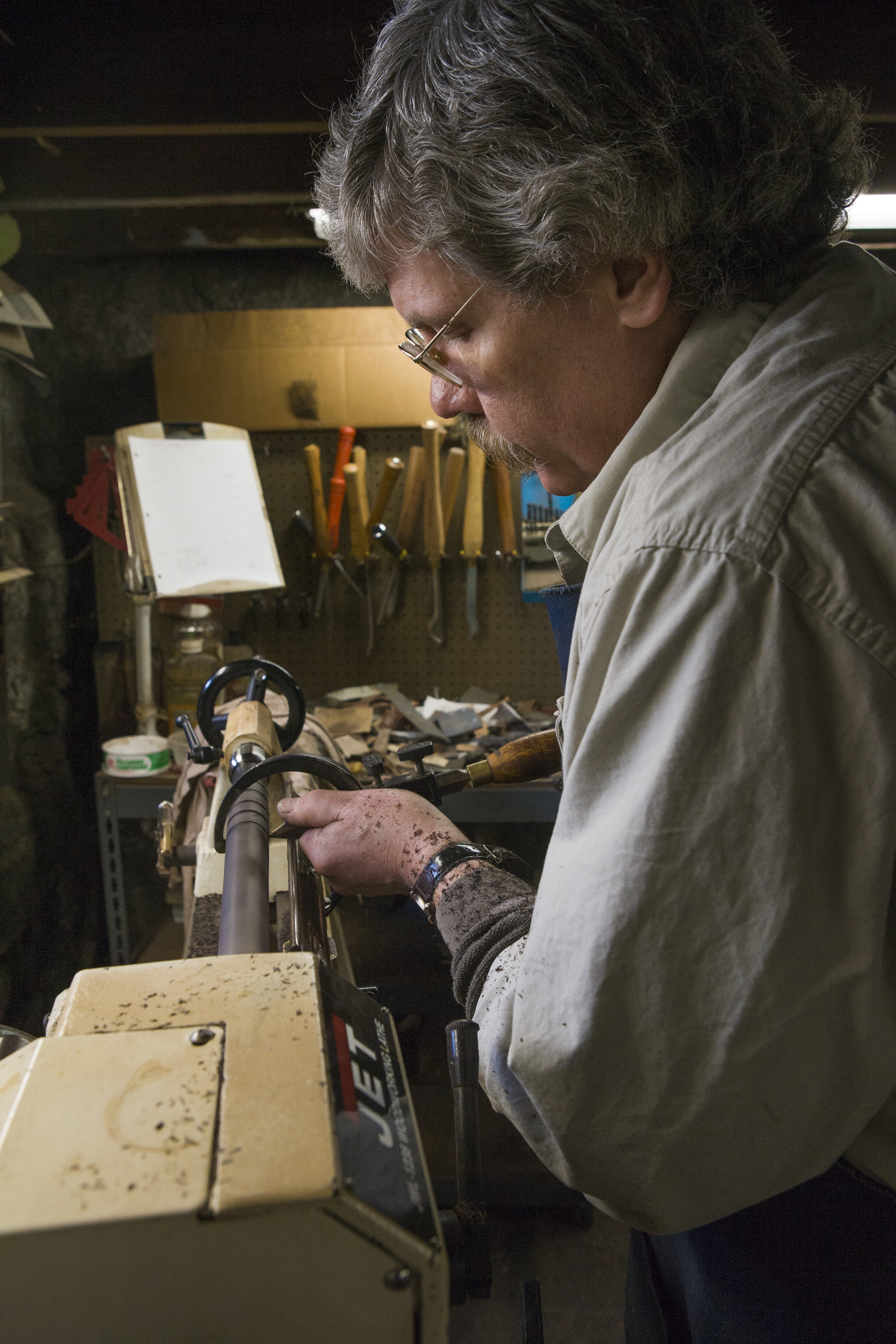
The workshop: My current workshop is located in a dank dark basement in my home in Kennebunk, Maine. It is the perfect space in that a previous inhabitant had established a workshop for model trains. About 2/3 of the basement is lined with vintage workbenches, shelves and drawers that were here when I got here. My day consists of the usual things most people do in the morning plus looking at bills and bank accounts. Then, it's off (down) to the shop. What I do in a day depends on the situation. I might spend a whole day drilling and reaming a chanter bore as it is a slow and methodical process. Other days may be spent on more mundane and repetitive tasks like cutting bags out of leather or nailing together a set of bellows. After dinner, I might be ordering tools and materials. Sometimes, depending on schedule, I work into the night as that is when I do my best work. That is usually the time I devote to making reeds. I use turning lathes as my primary tools. I have 2 wood turning lathes, one for rough and finish turning and the other for boring and reaming. And, I have a machine lathe for the metalwork. The rest of my tool set consists of tools that could be found in any workshop. There are some specialized tools such as gun drills for pilot bores and a set of tapered reamers that I make myself. I use any species of wood that is suitable for woodwind instruments. But, my favorite wood of all time is, and always will be, African Blackwood.
Since 1987: Most of the change has been the growing interest in the Uilleann Pipes worldwide. Most of my early clients were American or Canadian in the early years. Now, I have sent pipes all over the world. I have learned that there are no shortcuts to making Uilleann Pipes and that things can go wrong for unforeseen reasons. Climate has a lot to do with it. Natural materials react differently in New England than in Arizona than in Florida. Even with a single crafts-person, a slow evolution takes place as the need and new technology is applied. I don't make exactly the same instrument as I did 30 years ago. For instance, I now use coil springs for keysprings instead of the traditional leaf springs that I used to use. They are much easier to install, adjust for tension and replace when worn. When someone praises the pipes I sent them, I'll reply, Wait 10 years — I'll make you a better set.